

Job interviews are interesting. On the one hand, you’re excited that someone has acknowledged your alignment with the role and wants to learn more. Yay! On the other, though, is the stress about how to answer the dreaded interview questions. Ugh. Many thoughts can go through your head while preparing for that interview: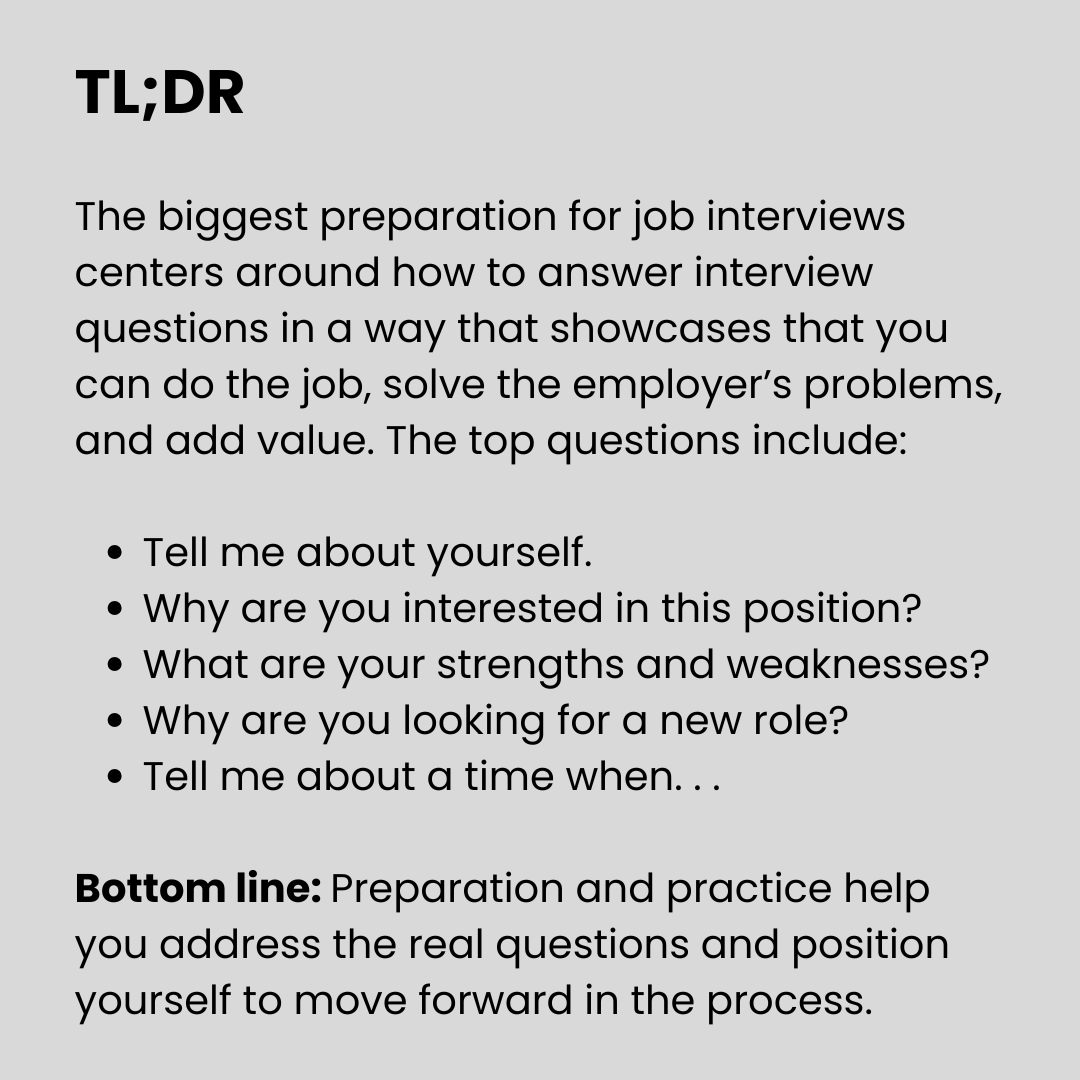
- Which questions will I be asked?
- What should I ask the interviewer?
- How much of my personality should I let in?
- Is it possible to over prepare?
Believe me, I’ve seen and heard it all over the years, and while I can certainly provide some direction on how and what to prepare for any level of interview, the truth is that I don’t have a crystal ball. You can do everything you can to prepare—and you’ll also need to understand the job description, company, and your talents to really ace the interview.
Yes, you absolutely should prepare for the interview, let your personality come through (because people hire people), and have great questions to ask—all without sounding as if you’ve rehearsed in the mirror for hours.
“Tell me about yourself.”
The first question you’ll probably be asked in every interview is all about you. Well, it’s kind of about you. The challenge is that many job seekers answer this interview question from a social perspective:
“I’m married and have two kids. I was born and raised in Washington and moved to Texas 10 years ago. I enjoy cooking and gardening and like to travel as often as possible.”
Technically, that does answer the question. What it doesn’t do is tell the interviewer anything about how you’ll add value in the role. And that’s the rub. How do you let your personality come into the conversation and share about who you are as a person while still focusing on your value add?
The answer is simply to flip things around.
When asked, “Tell me about yourself,” it’s important to remember what the interviewer really wants to know:
- Can you do the job?
- Can you help solve our problems?
- Will you fit with our culture?
If you can nail those three components and add a little personality, you’re golden.
Sounds easy, right? Easy on paper, maybe; in practice, it’s a whole different matter.
A Framework to Answer, “Tell Me About Yourself”
Don’t confuse this question with, “Walk me through your resume.” While you may also get that question, when asked this first question, you’re better off following a simple format:
- Where you are now. Briefly describe your current (or most recent) role, area of expertise, or professional focus.
- What you’ve done. Highlight a few experiences or accomplishments that are particularly relevant to the position.
- Where you’re going. Explain what you’re looking for next and why this opportunity interests you.
Here’s an example:
“I’m currently a marketing director specializing in B2B technology companies, with a particular focus on building integrated marketing strategies and leading cross-functional teams. Over the past several years, I’ve helped organizations reposition their brands and develop campaigns that significantly increased qualified leads. I’m excited about this opportunity because I’ll be able to combine that strategic experience with more responsibility for overall growth, which is one of the things that attracted me to this position.”
Your answer should tell a story about where your career is headed based on your background. And if you want to include a bit about yourself, go for it. In fact, some people will even incorporate information about why they’re looking now, aiming to knock out a few questions with one answer.
The biggest things to remember in your answer to this and all interview questions are to be authentic, engaging, and brief. Most answers come in at around two to three minutes. It’s better to leave them wanting more (and asking you more questions!) than for them to be glancing at their watches.
“Why Are You Interested in This Position?”
When asked about your interest in the job for which you’re interviewing, you may be inclined to say something like, “A paycheck is better than no paycheck.” Let me just tell you: That’s not the right answer. Even if you are currently unemployed or gunning for your first job after some time off, an interviewer doesn’t want to know you’re interested in the salary.
Nearly everyone needs income. Put that aside for a moment. Why this job? Even if any job will work for your bank account, you’re not interviewing anywhere; you’re interviewing here. Therefore, you need a specific answer as to why you’re sitting in the hot seat.
The interviewer wants to know if you’ve thought about how your interests and experience align with what the organization needs in this role. To prepare, you have the cheat sheet: the job description. Refer to that to point out how you’re able to add to the company by meeting—and exceeding—the needs of the role. Ideally, you’ll incorporate aspects such as the challenges the employer is aiming to solve and how your talents connect to those needs. Your answer will then help them make the connection.
For example:
“I’m really drawn to the opportunity to build out the company’s internal communications strategy. I’ve spent the last several years developing communications programs during periods of significant organizational change, and I enjoy the challenge of helping employees understand not just what is changing, but why. I can bring that experience here to help you scale along your proposed timeline.”
Just like people enjoy hearing how awesome they are, employers like hearing how awesome their company is. By sharing how you can help, that’s essentially what you’re doing.
“What Are Your Strengths?”
I’m not a huge fan of the strengths and weaknesses questions, but employers sometimes do ask them, and you should be prepared. In both cases, candidates are apt to give generic responses, such as strengths of being good with people, a hard worker, or super organized. Those aren’t bad responses, but they don’t really say much.
A better answer to the interview question about strengths is to highlight something that is integral to the position. For instance:
- customer service → working with people
- leadership → coaching and management
- IT → technology
If you can integrate an accomplishment, so much the better! For instance, if you’re applying to a project management role, you can share the strength of organization—and go a step further:
“I’m an excellent project manager, and one of my talents in that arena is engaging stakeholders, helping to keep them rowing in the same direction. In my last role, we worked with a diverse base, and I coordinated weekly check-ins across departments to share progress and ensure everyone was meeting timelines. Because of that level of integration, we were able to complete the project ahead of schedule.”
This not only tells the interviewer a fact, but it also backs it up with a story. In an interview, the sales approach of “facts tell; stories sell” is 100% true. Your stories will help employers see the true connection behind what you did and how it made a difference.
“What’s Your Greatest Weakness?”
The second half of the equation is your weakness. Ugh. No one wants to admit to a weakness when being judged in an interview, so they may opt to fall back on something that’s a strength disguised as a weakness, such as being a perfectionist.
Not only is this a canned response, but it says a whole lot of nothing. It adds no value to the company. At all.
As with the strengths question, you want to be specific here, talking about a true weakness—yet one that you’ve overcome (or are in the process of overcoming). One approach is:
“Earlier in my career, I tended to take on too much myself because I wanted to make sure everything was done correctly. As I’ve moved into leadership roles, I’ve learned that effective delegation isn’t just about getting work off my plate. It’s an important part of developing my team. I’ve become much more intentional about delegating ownership, not just tasks.”
That answer illustrates self-awareness. You’re not saying that you’re perfect and have no weaknesses. Instead, you’re demonstrating that you recognize an area for improvement, you’ve taken responsibility for it, and you’ve changed your behavior. That’s a much more compelling answer.
Behavioral Questions: “Tell Me About a Time When…”
I mentioned earlier that stories sell—and there’s no better place to incorporate stories into your interview answer than with the “tell me about a time when” questions. Typically, they’re followed by a challenge, which leads right into an accomplishment and then *bam* you have a great story about how you’ve added value.
You may have used STAR, CAR, PAR, BAR, or some other acronym to think about accomplishments. I’ve always used CAR:
- Challenge
- Action
- Result
That’s great to get you started, and if you were working on a resume, you’d stop there. However, in an interview, you can up the ante with one more letter: T for takeaway (or L for learning, but I like CART better than CARL). A takeaway says what you learned through overcoming that challenge. Being coachable and a lifelong learner is something most employers love to see, so show them!
Stories tend to run long, so make sure you have some great accomplishment stories to share that are succinct and engaging. Again, aim for two to three minutes. You can always ask something such as, “Does that answer your question?” And if needed, you can clarify.
“Why Are You Looking for a New Role?”
Whether you’re employed and looking for a new challenge or were laid off and need to get back to work, this question has to be addressed. And on the surface, it may seem easier than it turns out to be. However, there can be many emotions associated with job searching. You could be looking to escape a toxic work environment, aiming for a salary increase, or navigating an emotional layoff. All of these situations could lead to a not-so-great response to this interview question.
Here’s the formula to consider for your response: Address the situation briefly and then shift to your future at this company:
“I was recently laid off when my company downsized, and that’s given me the opportunity to aim for a leadership role. I’m excited about joining this organization because I can leverage my skills in collaboration to support the team and help them achieve our shared goals.”
There’s no reason to belabor the question any more than that.
“Do You Have Any Questions for Us?”
You should always have questions to ask during an interview. Why? Because you’re interviewing them as much as they’re interviewing you. This is a conversation, and you should be learning as much as you can about the company, role, and people so you can make an informed decision as to whether or not this position will work for you.
Compile your questions ahead of time and during the conversation itself, as you think of additional things to ask. Remember that you want to ask good questions. “What does this job entail?” is not great; the job description tells you that. Try “What does a typical day look like for you/the team?” or “How will you measure success in this role in the first 30 days?”
Leverage AI Tools to Answer Interview Questions
I don’t always suggest using AI in a job search, but it is excellent for interview prep. You can input the job description, along with the LinkedIn URLs for the interviewers and yourself and the type of interview (phone screen, hiring manager, panel) and then ask:
- Give me X questions I should be prepared to answer in this interview.
- Give me Y questions I should ask during this interview.
By adding in information about the involved parties, you’ll get much better outputs. Remember that AI can’t foretell the future any better than you or I can, but it can dive into the job description to give you more focused questions than are outlined here.
You can also practice interviewing by using AI. Yoodli.ai is a great role-playing AI that puts you in front of a lifelike avatar and provides real-time feedback. If nothing else, definitely record yourself answering questions so you can see how you look and if you use too many filler words. Those “um” and “uh” pauses can diminish your credibility quickly.
What If You Don’t Know the Answer?
The thing about behavioral questions is that they really dive in to how you might do things and solve problems, but they can be sticky sometimes. For instance, what if you don’t have an answer to something? It can happen when you truly haven’t experienced that situation or, perhaps more commonly, you just can’t think of a situation at that moment.
If you get stuck, extrapolate. In both of those instances, you can answer similarly. Start with, “I don’t think I’ve had that happen before. . .” or “I’m sure that’s happened to me, but I can’t think of a time at the moment. . .” and then continue with something like:
“. . .however, if I were faced with that issue, I would probably handle it and I might expect this outcome .”
Remember that interview questions—and your answers to them—are more about your critical thinking and problem-solving skills than they are about the actual answer.
The Best Interview Answers Aren’t Really About the Questions
Here’s the thing about interview questions: The interviewer isn’t actually that interested in your ability to answer interview questions. They’re interested in you. They’re looking to determine:
- Can you do the job?
- Will you fit with the team?
- Can you solve the problems they need solved?
- How do you handle challenges?
- How do you communicate?
- Will you take ownership?
- Are you coachable and can you learn?
That all happens through your answers as well as your demeanor, professionalism, and—yes—personality. We hire people we like, so be likable. When you’re likable and knowledgeable, you’ll create the perfect balance to move toward the next steps.
***
I don’t give busy work; I deliver proven strategies. As Your Career Advocate, I guide and support you from initial application through salary negotiation. Learn more about my services.